

Introduction
The Old Testament is written in Ancient Hebrew, with a few sections (mainly in Daniel and Ezra) in Aramaic, which is similar. Ancient Hebrew is not exactly the same as Modern Hebrew. Ancient Hebrew stopped being spoken over one thousand years ago, and Hebrew was only revived as a widely spoken language after Israel once again became a nation in the previous century. This Modern Hebrew has changed and adjusted a number of things about Ancient Hebrew to adapt it to their needs.
Hebrew is a Semitic language. There are some things common to Semitic languages that are not found in Indo-European languages like English, Greek, Latin, and Spanish.
The Hebrew Writing System – Lesson 1
There are two major differences between the English and Hebrew writing systems (besides the alphabet):
First, Hebrew is written backwards – from right to left. To read Hebrew, you begin with the right side of the book instead of the left side. You start with the page on the right instead of the page on the left. You begin with the word on the right end of the line, and you read each word starting with the letter on the right and ending with the letter on the left:

Second, Hebrew did not originally write down their vowels. Only consonants and gutturals were written down. Hebrew words had vowels, and they were spoken using vowels, but the vowels were not written down. Because of that the above line would look like this:

Later, some scribes invented a system for including the vowels. They added small symbols around the letters, like this:

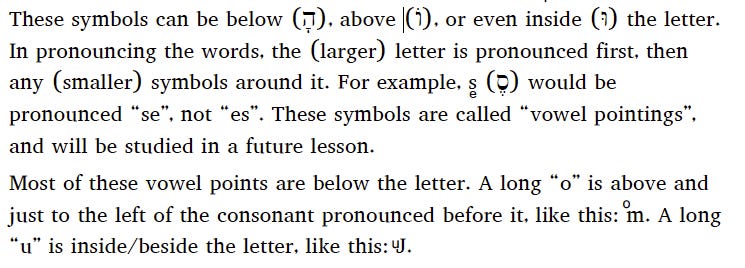
Some further examples:
